


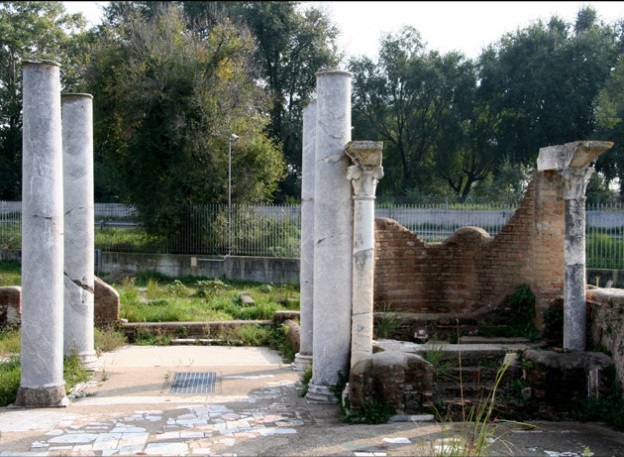
The ruins of the Ostia synagogue, discovered in 1961, are a crucial piece of evidence, telling us as much about the Jewish presence in the region as they do about the most ancient Jewish diaspora organisation. The primitive section dates from the 1st century, when the port built by Emperor Claudius turned the city into a multi-ethnic trading centre. The building had many rooms, and was later renovated and enlarged, particularly in the 3rd and 4th centuries. The sanctuary was accessed through a vestibule with three entrances and an intermediate passageway with tall Corinthian columns. The tevah is thought to have been on the slightly curved wall at the back of the room; on the opposite side you can still see the 4th century apse which made up the aron, framed by an aedicule originally with trabeated columns. Decorative bas-reliefs with traditional subjects are at the top of the projecting ledges are: the menorah, the shofar, and lulav.
Additional rooms in the space near the vestibule date from later transformations, including a kitchen with an oven and sunken compartments for provisions, and a large room with benches along the walls, perhaps used as guest quarters.
Viale dei Romagnoli, 717 – Ostia Antica – Rome
Information and contacts: http://www.ostiaantica.beniculturali.it


